 Click the arrow to go up a level to the Records Archive.
| Follow the above link to the directory for the archives or click the graphic below to visit the Homepage. |
 | The Old Cullen Family Seat
at Cullenstown, Co Wexford
Jim Cullen |
There is now a Photo Gallery of Cullenstown, from pictures taken by Charles Cullen on his visit there in June of 2000. Many thanks to Charles for allowing his pictures to be posted for the rest of us to enjoy. There are no photos of Cullenstown Castle on the internet that I've ever been able to find so, for many of you, this may be your first chance to take a peek at the old Cullen Family seat in Cullenstown, Co Wexford. Please give the page a minute or two to download - I've done my best to make the wait bearable and still provide worthwhile images.
This information has been relocated from the Posting Page for Co Wexford due to its size. I hope to add more information on our family's old Norman seat at Cullenstown, including a map and more information on Cullenstown Castle itself. If you want to add to this page, even if it's just one tidbit you are able to give, your help would be very much appreciated. Just use the below link to send your information via e-mail and include the source of the info, if possible.Click here to contribute your information regarding Cullenstown.
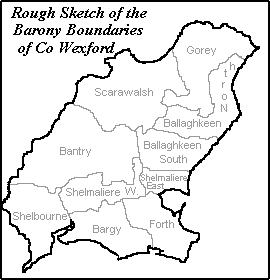 | Map: Details to be added. |
The Cullens of Cullenstown (Ballycoloun), Co Wexford
In Hilary Murphy's Families of County Wexford, we find mention of the Cullen family as the "Anglo-Norman" Colyns who were prominent in Co Wexford up until the arrival of Cromwell (1649). We find very similiar names in Co Kent, England during the 15'th century. Spelling variations in Co Kent, according to land deeds of the time, are given variously as Colyn, Colyne, Colyns, and Colin, with Colyn being by far the most common variation, evidently the accepted spelling at that time. It can be conjectured that the Cullens were a Norman family that migrated across the channel between France and England, some time after the Norman conquest of England in 1066. Norman merchants and artisans came to England during this time to set up shop in the "new world". From one of the branches of this family may have sprung the line that eventually found its way into Ireland a hundred years later.
It is said that the Norman ancestors of the Cullen family were planted in Wales and then later participated in the "invasion" of Ireland in 1169. Rather than an invasion, the Norman conquests were more than just a single event. Often there were precursory settlements of the Normans, preceding an actual "invasion". For some time after their formal arrival, further Norman settlement would occur as families moved into the area to take advantage of the opportunities in the new territory. In Ireland, the Norman family was prominent in Co. Wexford. Their seat was at Cullenstown Castle in Bannow Parish near where the Normans first landed in force in 1169. They retained their position for quite some time and Cullen of Cullenstown is listed among the leading gentry of Co. Wexford in the Clongowes Manuscript of 1598. There are many mentions of early Cullens in Co Wexford from The Civil Survey of Wexford 1654-1656, Knights Fees in Co Wexford, The Leinster Inquisitions, and other sources many of which are quoted in Hore's History of Wexford. Among those early Cullens mentioned are:
- Cullen: The family of Cullen had been settled at Cullenstown since at least as early as the fifteenth century. Note that there are at least three locations, probably more, that have been named for this family. There is Cullenstown, Cullens Newtowne, and Cullensland. Cullenstown, also known as Ballycoloun, is on the southern shore in the barony of Bargy. According to one source, some members of the O'Cuilinn sept that held Glencullen (Gleann Cuilinn) in Co Wicklow had migrated to Co Wexford and settled to refound the sept there. A sept of O'Cuilinn is noted near Tintern. These Gaelic families are distinct from the Norman Cullens who settled in the same area and sorting the two groups from one another is a near impossible task.
- John Cullen: An inquisition at New Ross on Apr 14,1467 concerning one John Cullen who died seized of much property, including Cullenstown Castle, in the lands around Bannow.
- Richard Cullen: Was granted a holding in the parish of Selskar in 1537. Another Richard Cullen or possibly the same one, was accused in 1552 of the illegal export of goods from Co Wexford.
- Laurence Cullen: A juror for an inquisition in Co Wexford in 1543 was Laurence Cullen, of Cullenstown.
- James Cullen: In 1567, at the age of 80, one James Cullen was questioned by the Bishop of Ferns about the boundaries of lands in the Barony of Bargy.
- John Cullen: M.P. in 1634 for Clonmines, this John Cullen is mentioned as holding 180 acres in the parish of Bannow in 1640.
- Thomas Cullin: An Irish Papist of Cullinstown who held his land as in 1640 as an inheritance from Thomas Cullin, also an Irish Papist.
- Landowners: These Cullens, all Irish Papists, were listed among the prominent proprietors of Co Wexford in 1641 in the Civil Survey: Thomas Cullin of Cullinsland, Laurence Cullin of Black Hall, Patrick Cullon of Philips Brown, and Richard Cullin of Cullins Newtowne. They all held their land from John Cheevers of Co Meath. The Cheevers (or Chievres) family, another Flemish family that arrived about the time of the Norman Invasion, is also associated with Kiliane in Co Wexford (and also, it seems, with land in the barony of Killian, in Co Galway). The name Cheevers is also associated with Counties Carlow, Dublin, Meath, and Wicklow.
- Thomas Cullen: Thomas lived in Cullenstown and was described as one of the "Gentlemen of ye County" by Lord Esmonde in 1643 and was targeted by Cromwell to be heavily penalized for his activities. He is likely the same as the Lt-General Thomas Cullen who forfeited 222acres in 1641. Lt-General Cullen commanded the rebel army in 1642 at the Battle of Ballinvegga with General Preston. Another Cullen, Richard, of Cullen's Newtowne, forfeited 176acres.
- Thomas Cullen: Thomas Cullen of Cullenstown was born about 1633 and married Martha Colclough, who was the 2'nd daughter of John Colclough of Pouldarrig and Katherine Synnot of Rosegarland. John Colclough was the son of Thomas and Martha (Loftus) Coulclough, of Rathfarnham. John is likely descended from Sir Anthony Colclough, a member of the Staffordshire who was a soldier in the Queen's army. Anthony arrived in Ireland in 1543 and was granted, in 1575 by Queen Elizabeth, all lands and estates of the old monastary of Tintern Abbey in Co Wexford. Suffering the same fate as the Cullens and other Catholic families, these lands held by the Colcloughs were lost during the Cromwellian confiscations of the 1640's. Listed among the estates was Bally Cullan (or Coloun), the old name for Cullenstown. The Colcloughs regained their holdings after 1665 under the terms of the Act of Explanation. The Colcloughs lived in the old Abbey until as recently as 1958 when Miss Lucy Colclough turned it over to the Irish government. The property is now maintained as a historical site.
- Mr. Cullen: Noted as having held a Commision in the Irish Army during the Confederate War against Cromwell in 1649-1651 and likely the same as Lt-General Cullen above.
- Cullen and O'Cullen: The distinction between the two names Cullen and O'Cullen was recognized in the 1659 census in Co Wexford which reports that 25 Cullins or Cullens (Normanised families) were living in the baronies of Bargy and Shelbourne, while a greater population of 140 O'Cullins or O'Cullens were living in the Irish baronies of Shelmalier (East and West).
Click here to return to the Records Archive main page